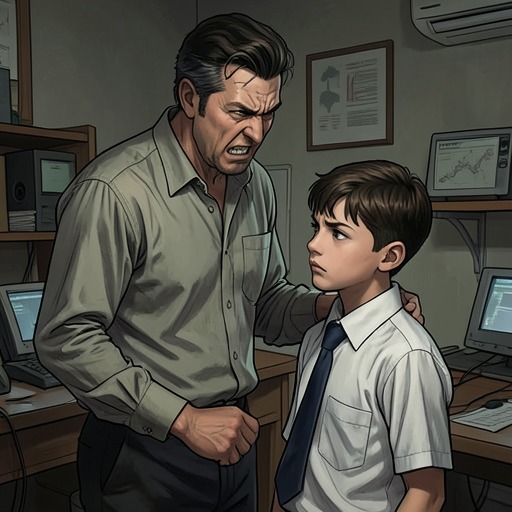
Kenkichi Kobayashi and Makoto Hara’s father–son relationship
A ManKenkichi Kobayashi and Makoto Hara’s father–son relationship is defined less by any shared life than by the burden of Kenkichi’s crimes and Makoto’s fear that he might inherit his father’s nature. Makoto does not commit the crimes that made his father notorious, but the possibility of being shaped by that inheritance shadows his identity, his ambitions, and the family he later makes.
A Father’s Crimes and a Son’s Fear
Kido’s account of Makoto’s life begins with Kenkichi’s upbringing and the murders he committed, then follows the consequences for Makoto: he is bullied, abandoned by his mother, and sent to an orphanage. The account connects these experiences to a son growing up under the weight of a father’s criminal past, though the evidence does not describe a close or sustaining bond between them.
During Makoto’s boxing years, he agonizes over his genetic inheritance. The fear is personal and prospective: the crimes belong to Kenkichi, but Makoto worries about what his parentage might mean for the person he could become. His professional debut is followed by an accident that brings his boxing dream to an end, adding another rupture to a life already marked by abandonment and stigma.
The Past Reaches Makoto’s Family
Long after Makoto’s death, Rié learns from Kido’s report that her husband was Makoto Hara and that his father was Kenkichi Kobayashi. She had never known Kobayashi’s name or connected the crimes to her own family; reading the details leaves her distressed by the realization that a history she had considered remote was linked to the man she loved. She also recalls that Kyoichi had suggested her husband committed a terrible crime, but the report clarifies the distinction: Makoto was the son of a killer, not himself the perpetrator.
Rié wonders whether Makoto’s invented account of Daisuké’s life was a way of communicating his own deep wounds. She cannot know why he chose that particular disguise, but she recognizes that a distorted account can carry genuine pain even as it makes understanding and care more difficult. His secrecy therefore complicates, rather than cancels, what Rié comes to understand about his suffering.
Inheritance, Care, and What Passes On
Makoto’s fear also matters to Rié as a mother. She is not troubled by the possibility that Hana carries a murderer’s blood, but she worries that her daughter might one day despair if she learns the truth. Yuto, by contrast, has no biological connection to Makoto; Rié considers that difference when deciding how carefully to share the report with him. The novel thus distinguishes biological descent from the emotional effects of family history: the secret can trouble the people who learn it even when they do not share the same ancestry.
When Yuto begins to understand why Makoto treated him so kindly, he suggests that his father gave him what he had wanted his own father to give him. Rié agrees, while adding that Makoto also cared for Yuto himself. The relationship with Kenkichi is therefore recalled through the care Makoto offers the next generation: the evidence does not establish that this care repairs his relationship with his father, but it shows Makoto acting toward Yuto with a tenderness that Yuto understands as answering an unmet need in Makoto’s own childhood.
Narrative Significance
The father–son relationship joins questions of inheritance to the distinction between a person and the story attached to his family. Kenkichi’s crimes are real, but they do not determine Makoto’s conduct; Makoto’s anxiety about that possibility is itself part of the pain Rié discovers in his history. His eventual explanation is not a clean separation from the past, but a more difficult recognition: his suffering was real, his life cannot be reduced to his father’s crimes, and the care he gave Yuto can be understood alongside the wounds he carried.